How Cold Promotion Works: Turning Outreach Into Customers with Choco Mailer
Cold promotion is more than blasting emails. It is a system of targeting, sequencing, and measuring. Here is how to build a cold promotion engine that converts, and how Choco Mailer powers it on your own server.
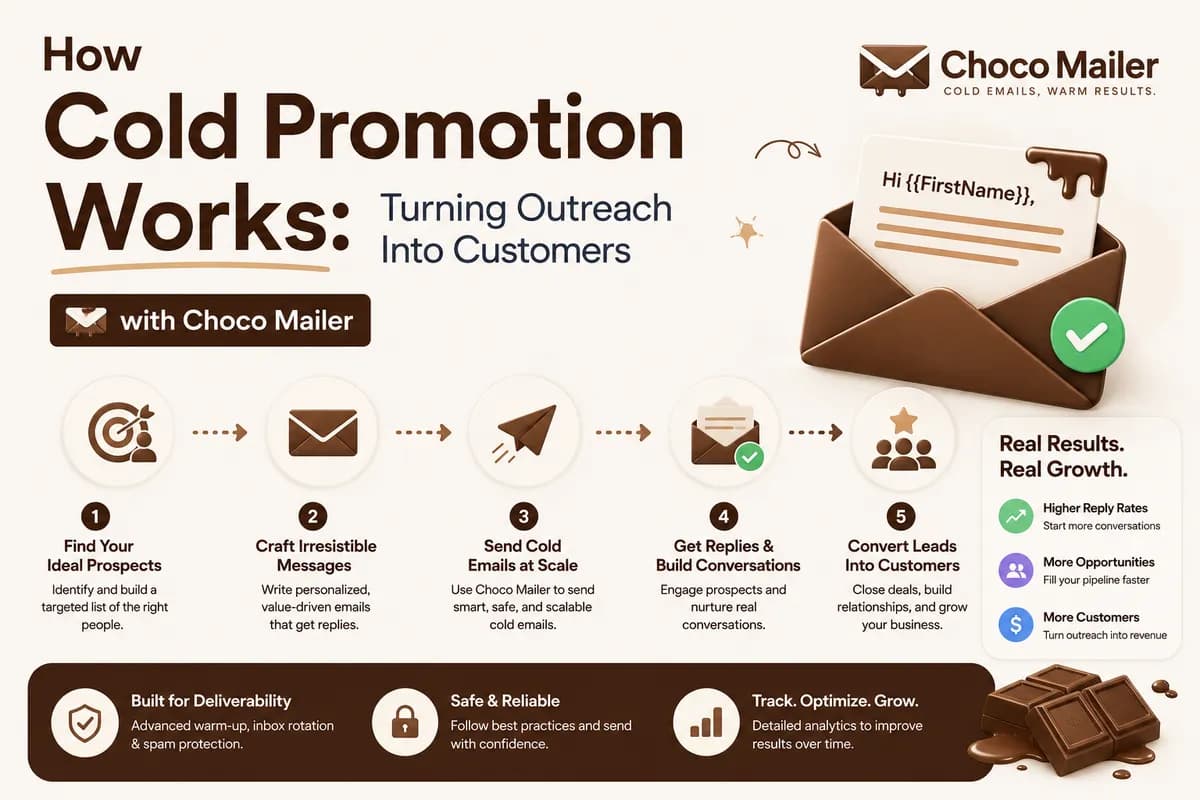
"Cold promotion" sounds like a numbers game, but the senders who win treat it as a system. They target carefully, sequence their messages, and measure everything. In this guide we break down how a cold promotion engine actually works and how to run one on infrastructure you fully control.
Step 1: Define your audience before you send a single email
The most common mistake in cold promotion is starting with the message instead of the audience. Before writing anything, answer three questions:
- Who has the problem my product solves?
- What does a good-fit prospect look like (industry, role, company size)?
- Why would they care right now?
A tight, well-defined list of 1,000 relevant contacts will outperform a random list of 50,000 every time.
Step 2: Build a sequence, not a single email
People rarely reply to the first message. Cold promotion works through follow-up. A simple, effective sequence looks like this:
- Email 1 — The hook: A short, relevant message that names a specific problem.
- Email 2 — The proof: A quick example or result that builds credibility.
- Email 3 — The nudge: A friendly reminder with one clear call to action.
Most replies come from the second and third touch. Stopping after one email leaves the majority of your results on the table.
Step 3: Protect your deliverability
Cold promotion lives or dies by inbox placement. To keep your mail landing where it should:
- Authenticate every domain with SPF, DKIM, and DMARC.
- Warm up new domains gradually instead of sending at full volume on day one.
- Clean your list and remove invalid addresses before each campaign.
- Spread sends across time rather than dumping everything at once.
Step 4: Measure what matters
Opens are a vanity metric. The numbers that actually tell you if your cold promotion works are:
- Reply rate — are people responding?
- Positive reply rate — are the responses interested, not annoyed?
- Complaint rate — keep this as close to zero as possible.
- Conversion — meetings booked or sales closed.
Where Choco Mailer fits in
Choco Mailer is a self-hosted bulk email platform that gives you the engine to run cold promotion at scale, without handing your reputation or your data to a third party. It deploys directly to your own server and supports SMTP, Microsoft Graph API, and Firebase sending out of the box.
Why senders choose a self-hosted engine for cold promotion
- Full control of reputation: Your sending domains and IPs are yours alone — no shared pool to drag you down.
- No per-email pricing: Scale your volume without watching a meter.
- Data ownership: Your contact lists and campaign data stay on your infrastructure.
- Multiple sending methods: Switch between SMTP, Graph API, and Firebase depending on your needs.
Putting it all together
Effective cold promotion is a loop: target a tight audience, send a thoughtful sequence, protect deliverability, measure the right metrics, then refine and repeat. With a self-hosted platform like Choco Mailer running the sends, you keep every part of that loop under your own control.
Want to run cold promotion on your own terms? Get Choco Mailer and deploy your own sending engine today.
Related Articles
PowerMTA Error Codes: Diagnose and Fix SMTP Response Issues
A practical guide to PowerMTA error codes: understand SMTP response classes, troubleshoot top 10 delivery failures, parse PowerMTA logs, and configure your server to prevent bounce-related issues.
Read more →
The Complete PowerMTA Setup Guide for High-Volume Email Sending
Learn how to install, configure, and optimize PowerMTA for high-volume email delivery. This complete guide covers DNS authentication, VirtualMTAs, IP warm-up, deliverability best practices, and scaling your email infrastructure.
Read more →
Cold Email in 2026: What Actually Works and Why
Cold email still wins in 2026 when it is done right. Learn what separates promotions that land in the inbox from ones that vanish into spam, and how a self-hosted setup gives you full control over deliverability.
Read more →